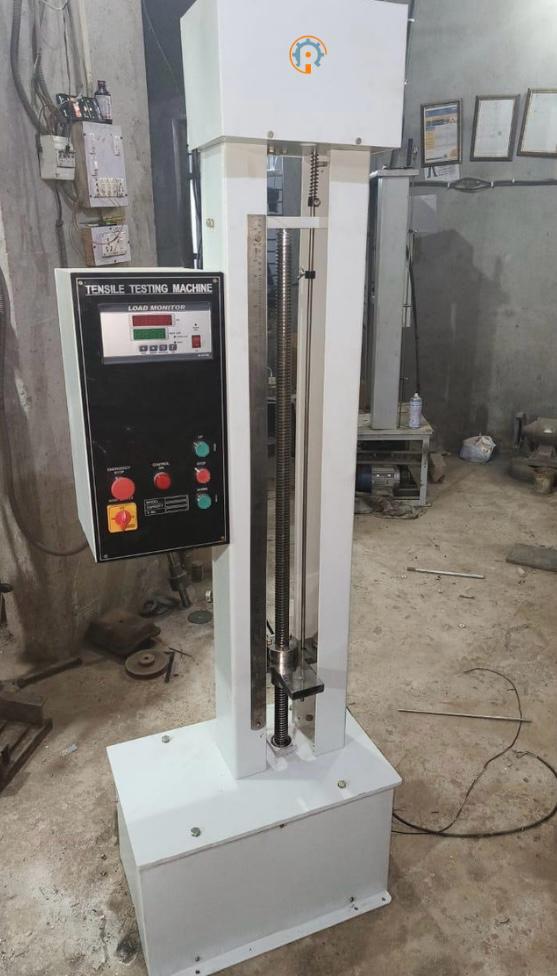
About Tensile Testing Machine
Tensile testing for rubber evaluates material strength and elasticity by stretching dumbbell-shaped or ring specimens until they break, typically following
ASTM D412 or
ISO 37 standards. Performed on universal testing machines at high speeds (mm/min), it measures key properties including tensile strength, modulus, and elongation at break, critical for automotive and manufacturing applications.
Versatile Testing CapabilitiesThis tensile testing machine supports a variety of test types, including tension, compression, bending, and shear, making it suitable for diverse material assessment requirements. Its robust, mild steel frame and wedge type grips ensure stability and secure sample holding during each test. Variable speed control enhances flexibility, allowing precise adaptation to different testing procedures and standards.
Advanced Digital Features and SafetyEquipped with a computerized system and digital display, the machine provides accurate, real-time data on load and elongation. The automatic grade operation reduces manual intervention, while integral overload and over-travel protection mechanisms safeguard both the operator and the device. These features ensure consistent performance, allowing safe and easy operation for a wide range of users.
FAQ's of Tensile Testing Machine:
Q: How does the Digital Tensile Testing Machine ensure precise measurement during tests?
A: This machine uses a digital display and advanced sensors to provide precise measurements with an accuracy of 1% of the indicated load, ensuring reliable and consistent test results across its 10-1000 kg load range.
Q: What types of materials can be tested using this machine?
A: The heavy-duty, mild steel construction and wedge type grips make it suitable for testing a wide array of materials such as metals, polymers, composites, and other engineering materials commonly assessed in industrial and research environments.
Q: When is it recommended to use the overload and over-travel protection features?
A: These safety features function automatically during every test, intervening whenever the machine approaches its load or movement limits. This helps prevent equipment damage and ensures operator safety during routine operation.
Q: Where can this Tensile Testing Machine be installed and used?
A: With its standard dimensions (approx. 1000x500x1500 mm) and 220 V, 50 Hz power requirement, the machine can be conveniently installed in laboratories, quality control departments, and manufacturing facilities across India.
Q: What is the process for conducting a tensile test using this machine?
A: To run a tensile test, position the specimen securely in the wedge type grips, select the desired speed using the variable speed drive, and start the computerized test sequence. Real-time load and elongation data are displayed digitally, and results are automatically recorded.
Q: How does the computerized and automatic operation benefit users?
A: Computerized, automatic functionality streamlines the testing process, minimizes manual error, and enables easy data collection and analysis, which ultimately increases throughput and efficiency for service providers, suppliers, and traders.





 Send Inquiry

 Send Inquiry
 Send Inquiry
 Send SMS